
Before you take your next bite...
Why one of Christianity's simplest practices may be one of the most important to recover.

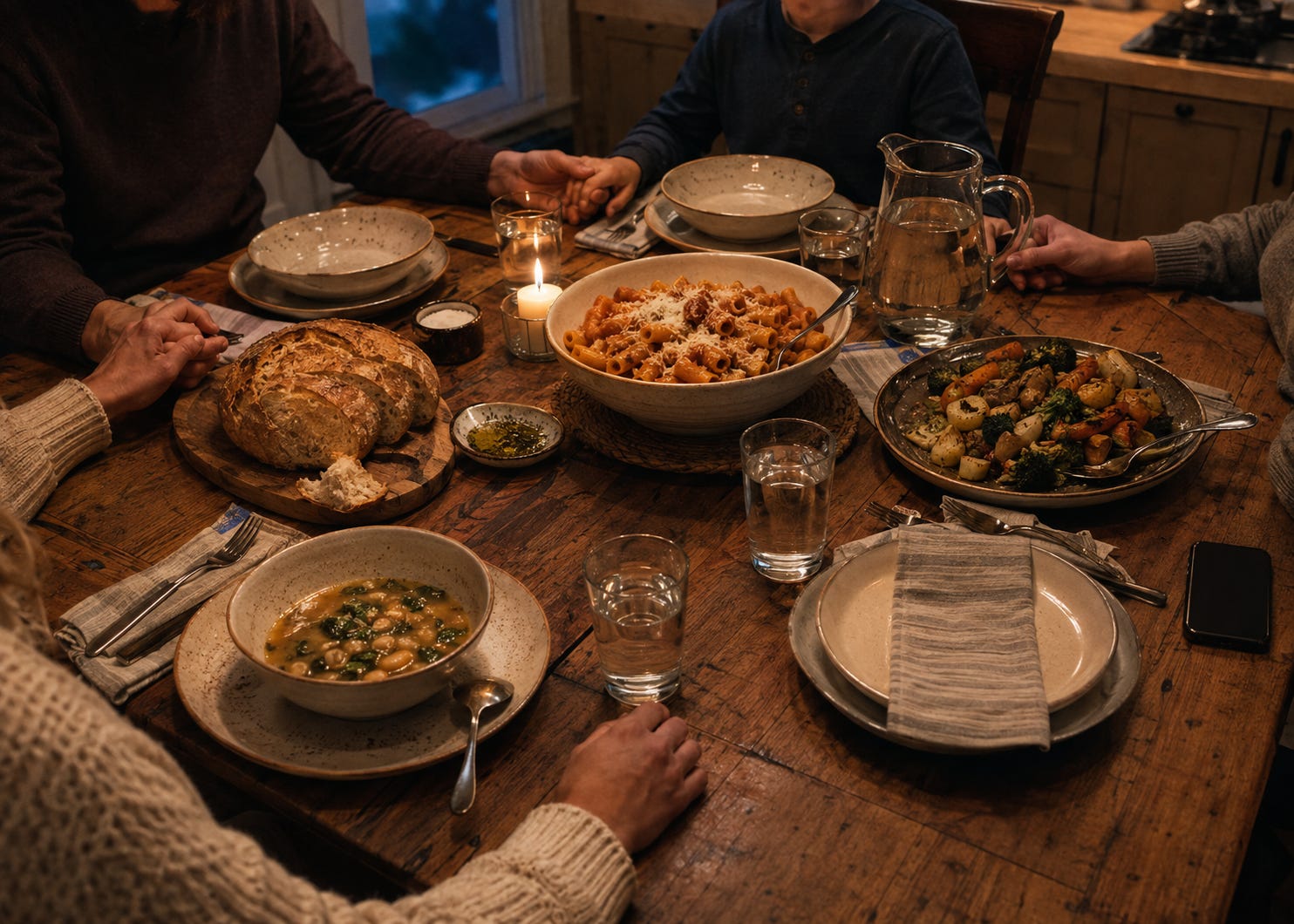
Good morning, my friends.
I love you all very much for bearing with me when I accidentally drop what amounts to a doctoral dissertation in your lap on a Tuesday morning. Today, we are going to choose a slightly gentler path.
And yes, I am aware that even my “short” posts are rather lengthy by Substack standards. There is, however, a method to my madness.
In a world increasingly organized around tweets, clips, captions, and fifteen-second bursts of information, I believe deeply in the importance of long-form content. Some increasingly concerning research suggests that we are losing our ability to remain attentive for any meaningful length of time. Some people are even finding sustained reading more difficult. Also, I’m afraid I cannot dance for you, offer you fitness advice, or show you my “fit,” as I wear the same outfit every day. All I have to give you are the spiritual treasures that were given to me... and they require more space than a fifteen-second video can contain.
So here at Message From the Margins, we take our time. We sit with difficult ideas. We follow an argument beyond the headline. We allow Scripture, theology, culture, human experience, and occasionally macroeconomics enough room to speak. Perhaps learning to pay attention is itself becoming a spiritual practice.
And speaking of taking our time, I am thrilled to announce that the Message From the Margins podcast will officially launch on the morning of Monday, August 17.
Our first episode is called “How the Bible Became the Bible.” Together, we are going to explore how the most important collection of writings in human history actually came to be: the unexpected path of its formation, the communities that preserved it, the decisions that shaped it, and some of the popular myths people use either to oversimplify the Bible or dismiss it altogether.
It will be thoughtful, accessible, occasionally funny, and unafraid of the complicated questions. In other words, it will sound very much like what we do here... except now you can listen while driving, walking the dog, cooking dinner, or pretending to organize the garage.
Much more is coming soon. For today, however, we are going to practice the sacred discipline of keeping things relatively brief.
Relatively.
Saving Grace
A small prayer before dinner can change the way we receive the world.
There are few moments in life more spiritually clarifying than realizing you have eaten half a sandwich without remembering taking a single bite.
I have done this more times than I care to admit. Lunch is sitting beside the computer. I am answering an email, reading the news, thinking about six other things, and suddenly I look down to discover that the sandwich has largely departed this life. I know where it went. I simply was not mentally present for the journey.
We eat in cars, at desks, over sinks, and occasionally while standing in front of an open refrigerator conducting a serious investigation into whether anything new has appeared since the last time we looked. Even when we gather around a table, the television is talking, the phones are glowing, and half the family is mentally somewhere else.
So I would like to recommend one small, ancient, thoroughly unfashionable practice: say grace before you eat.
Nothing elaborate. Ten seconds will do. Put down the fork, silence the phone, look at the food, notice the people around you, and say thank you.
This is one of the things I love about grace. It does not require a retreat, a workbook, or six Tuesday evenings in the parish hall. You already eat. The spiritual infrastructure is sitting right there beside the salt shaker.
Grace places a tiny speed bump in the middle of the day. For one moment, we stop treating food as something that simply appeared after we tapped a button and begin receiving it as a gift.
Yes, we paid for it. Yet money alone did not make it. Somewhere there was soil, rain, sunlight, seed, an animal, a farmer, a laborer, a truck driver, a grocery worker, a cook, and probably somebody washing a pan they would rather not be washing. An astonishing number of hands helped bring an ordinary Tuesday-night dinner to the table.
The economy trains us to look at the meal and see a purchase. Grace teaches us to look again and see a gift.
That little distinction can quietly change us. We live in a world forever encouraging us to acquire, consume, upgrade, and discard. Everything arrives with a price, so we begin to imagine that everything has been earned. Then ten seconds of prayer reminds us that much of what keeps us alive was here before we reached for our wallet.
We do not say grace because the mashed potatoes require an ancient ritual. We say grace because we require reminding that it didn’t come to us by our efforts alone.
Human beings have apparently always needed this reminder. Jesus was raised among a people whose days were ordered by blessing. The Jewish tradition does something beautiful here: the prayer is not primarily about making the food holy enough to eat. It blesses God, from whom the food has come. In the Gospels, Jesus takes bread, gives thanks, breaks it, and shares it.
Christians have followed that pattern ever since. Think of all the tables where someone has bowed their head and given thanks: monasteries and farmhouses, tenements and suburban kitchens, wedding feasts and hospital cafeterias… even in great palaces. Think of the grandparents whose familiar grace could be recited from memory long after nearly everything else about the meal has been forgotten.
When we say grace, we join them. For ten seconds, our little table becomes part of a very old and very large one.
For families, those few seconds may be more important than they appear. Establishing family prayer can sound like a noble idea right up until the alarm goes off, the school bus is coming, someone cannot find a shoe, and the dog has made an unauthorized theological contribution to the carpet.
But meals already gather us. Saying grace gives children a prayer they can carry for the rest of their lives. More importantly, it teaches them that gratitude is not merely a feeling that floats by when we are in a particularly lovely mood. Gratitude is something we practice.
Grace can also teach us to notice who is missing.
If we thank God that our table is full, sooner or later we must remember the tables that are empty. Otherwise, grace becomes little more than congratulating ourselves for having dinner. A blessing should widen the circle of our concern. It should make us more likely to feed someone, invite someone, donate something, or notice the person quietly wondering how groceries will last until payday.
A prayer over abundance has not quite reached “Amen” until some of that abundance learns how to travel.
And if you are eating alone, please do not skip grace because there is no one there to hear it. A table for one, as mine has often been, is still worthy of blessing. Thank God for the hands that brought the food to you. Remember someone you love. Pray for another person eating alone that evening. The empty chair across from you does not mean God has declined the invitation.
Now, because Christians are Christians, we should acknowledge that even a ten-second prayer can become a production number if we work hard enough.
There is a difference between praying where other people can see you and praying so that other people will see you. Jesus appeared to have some opinions on the subject.
You need not turn Applebee’s into the Sermon on the Mount. You need not pray loudly enough for the neighboring table to reconsider its life choices or for the server to wonder whether you are about to perform a minor exorcism over the mozzarella sticks. Make the sign of the cross. Join hands. Speak simply. The prayer is being offered to God, not submitted for the dining room’s approval. If the neighboring tables are unaware of what you’re doing, all the better I say.
And please do not worry about being eloquent. Use the words your family taught you: “Bless us, O Lord, and these thy gifts...” Or say, “God, thank you for this food, for everyone who helped bring it to us, and for the people gathered here. Remember those who do not have enough, and teach us to share.” I’ll share with you my personal “Grace Before Meals” prayer below, it’s a combination of what I was taught in the Seminary Refectory with a little flair of my own. Do with it what you will.
If that feels like too much, become quiet. Take a breath. Pay attention. Thank God in whatever words come. Actually, a lot of times, particularly if I’m alone, I just sit there in silent gratitude and make the sign of the cross. I suspect God likes that just fine, He probably gets tired of my yapping. (I’m kidding, He never tires of our yapping).
Try it at your next meal. Before the first bite, pause long enough to receive what is in front of you. Remember the hands that carried it. Remember someone whose table is empty. Notice the people you love, even if the only person at the table today is you.
Perhaps this is one of the ways grace saves us. Not all at once, and not with trumpets or thunder, but three times a day, at a kitchen table, over reheated leftovers, while someone is asking you to pass the salt.
The Grace I Pray at My Table
Several of you may want a prayer to help you begin, so I thought I would share the grace I ordinarily pray at my own table. Please feel free to use it, adapt it for your family, or make it your own.
Almighty Father, we turn to you with hearts filled with gratitude.
We thank you for the family you have prepared for us in the fullness of time. We thank you for the many blessings we enjoy, both those that come readily to mind and those that sometimes escape our notice.
Bless each and every one of us gathered at this table. Bless our friends and family, wherever they may be. Bless in a special way those who rest with you in heaven.
Please bless the food we are about to receive. We know how fortunate we are to have it. Bless the hands that prepared it and all those who played a part in bringing it to this table. Bless also those who will go without food today, and teach us to share generously from what you have given us.
In the name of the Father, and of the Son, and of the Holy Spirit.
Amen.
And now it’s your turn
Did your family say grace when you were growing up? Is there a prayer, a voice, or a table you still remember? Tell us about it in the comments, and before your next meal, take a moment to begin the practice again.
If someone came to mind while you were reading, consider sharing this reflection with them and inviting them to say grace with you.
Prayer for Today (We’re serving up lots of prayers today)
God of abundance,
You give us food for our bodies, people with whom to share our lives, and a world filled with gifts we did not create for ourselves.
Slow us down long enough to notice. Teach us to receive without entitlement, to give thanks without performance, and to remember those whose tables are empty. May every meal make us more generous, every table become a place of welcome, and every blessing draw us closer to you and to one another.
Amen.
There. A reasonably short reflection. By my standards, practically a refrigerator magnet.
I would love to hear about the grace you grew up saying, the person whose voice you still remember at the table, or the practice you would like to begin in your own home. Join us in the comments and tell us your story.
Nearly everything I publish through Message From the Margins remains available without charge because I never want money to stand between someone and the pastoral care, Scripture, or encouragement they need. Paid subscribers make that possible. If this work gives you something worth carrying into the rest of your day, please consider becoming a paid supporter. You will help keep the larger table open for everyone, and you will also be able to submit questions for “Queries From the Margins,” our paid-subscriber segment in the new podcast.
Either way, before your next meal, put the phone down, gather whoever is there, and say thank you. If dinner is merely something retrieved from the freezer and placed into the microwave, God has worked with less promising raw material.
This is a beautiful reminder. A speed bump in the middle of the day is a great way to view this practice. My family would hold hands in a silent prayer in restaurants. My parents stressed growing up that this was done silently so that someone watching would not feel less. My dad was a psychologist. Who worked with primarily at risk teens from children ‘s home that was an opportunity before being sent to a reform school thus the emphasis on others needs.
This is beautiful. Our family often holds hands while saying grace. Not sure how we started doing that but I like it. And sometimes we do it at restaurants too which I pray does not seem performative to others but rather a sweet tradition that warms their heart.