
Christian Unity Begins with Shared Love, Not Uniformity
Why conscience, humility, and care for our neighbor may be the Church’s only real path forward.

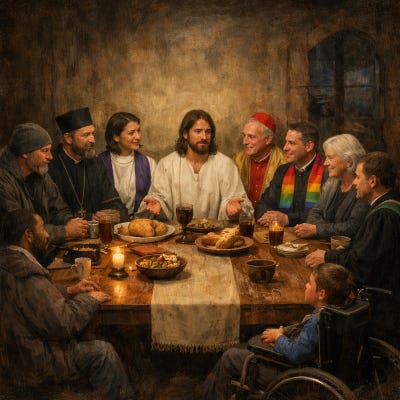
Opening
There was something quietly hopeful about the Week of Prayer for Christian Unity this year, which just concluded. (Sorry to be a bit behind schedule ~Fr. Rich)
For one week, Christians who disagree about almost everything still dared to say the same prayer out loud. We asked God for unity even while knowing how fractured the Church has become.
But I want to be honest about something that rarely gets said plainly in church spaces.
For a very long time, the working definition of Christian unity has effectively been this: all you have to do is agree with everything my denomination believes, acknowledge that we are right, submit to our leadership and then unity is achieved. The problem is that this is not unity. It is conquest dressed up in religious language.
I am not a diplomat, but my undergraduate political science classes taught me enough to recognize a familiar pattern. That approach only works if you have a massive enforcement mechanism standing at the gates. In the real world, that usually means an army. In the Church, it has meant shame, exclusion, fear, and the threat of spiritual abandonment or damnation. And in earlier centuries… yes, you guessed it, an army.
That may produce outward conformity. It does not produce communion.
As the Week of Prayer for Christian Unity concludes this year, I find myself less interested in renewed calls for agreement and far more interested in calls for faithfulness. Agreement has too often been demanded at the expense of conscience and love. Faithfulness, by contrast, asks whether our theology actually leads us toward Christ or merely toward control.
In his homily at Vespers concluding the week, Pope Leo XIV did not call for doctrinal surrender or theological conquest. He spoke instead of humility, mutual listening, and shared witness. His words quietly named what many Christians already know in their bones: unity cannot be imposed without breaking the body it claims to protect.
That is where my own conviction has settled.
The only path I see toward real Christian unity is not theological uniformity, but a generous allowance for diversity of conscience, anchored by a shared, non-negotiable mission: to proclaim the love of Christ and to care for our neighbor.
Anything else may look like unity from a distance.
Up close, it looks an awful lot like force.
Reflection
Jesus prayed, “That they may all be one” (John 17:21).
He did not say, “That they may all think the same.”
The earliest Christian communities were anything but uniform. The New Testament shows disagreement, argument, correction, and discernment unfolding in real time. Jewish and Gentile believers struggled to live together. Communities clashed over food laws, leadership, and moral expectations. And yet the apostles kept returning to one central question: does this build up the body in love?
Paul speaks directly to the role of conscience. “Each of us must be fully convinced in our own mind” (Romans 14:5), and then he offers a warning that feels strikingly contemporary: do not turn your conviction into a weapon against your sibling in Christ. Unity, for Paul, was never about erasing difference. It was about refusing to let difference become cruelty.
I say this personally, and not without some ache. I spent years believing that unity meant waiting quietly on the margins. That if I endured long enough, stayed agreeable enough, and loved hard enough, unity would eventually arrive. What I learned instead is that forced agreement does not create unity. It creates silence. And silence is not peace. It is simply absence disguised as order.
Pope Leo XIV’s reflection gestures toward a wiser vision. Unity, he suggests, is not something we manufacture by pressure or control. It is something we receive when we orient ourselves toward Christ together. Not as rivals. Not as enforcers. But as fellow pilgrims accountable to the same Gospel.
Jesus himself makes this plain. “By this everyone will know that you are my disciples, if you have love for one another” (John 13:35). He does not list correct theological applications as the test of faithfulness. He names love, costly, inconvenient, neighbor-centered love, as the mark of discipleship.
A Vision of What Unity Could Be
I sometimes allow myself to imagine what the Church might look like if we took Jesus at his word. Not his footnotes. Not our systems. His actual commission.
Picture a Church that has finally stopped exhausting itself by litigating every theological nuance as though the Kingdom of God depended on perfect alignment of language. Christ showed remarkably little interest in doctrinal micromanagement. He spoke instead about hungry people, naked people, prisoners, the sick, and the forgotten. He entrusted theology to lived love.
Now imagine this.
A married lesbian Episcopal bishop.
A Roman Catholic priest who celebrates the Mass exclusively in Latin.
A Greek Orthodox deacon formed by ancient chant and iconography.
No forced agreement. No pretending their differences do not exist. No demand that anyone betray the conclusions their prayer and conscience have led them to. And yet, standing side by side, working in full collegiality to feed the starving children of Gaza. Coordinating aid. Pooling resources. Praying together while respecting their traditions, then rolling up their sleeves and getting to the work of the Gospel.
The world would not ask about their internal disagreements.
The world would see the Gospel made manifest.
Some will hear this vision and immediately cry relativism. I understand the concern. And yes, if by relativism one means acknowledging that the Holy Spirit does not form disciples on an assembly line, then I suppose the charge sticks. But I would call it something else. I would call it seeing the bigger picture.
Unity does not require sameness. It requires shared direction. We are all on the same journey, even if we walk at different paces and pray in different tongues. And the commission Christ gave us is not ambiguous. Love one another. Care for the least. Bear fruit that lasts.
And here is the kicker. I suspect that if we allowed ourselves to be unified in this way, by loosening our grip on the need to be right and choosing instead to work, pray, and worship together, something surprising would happen over time. The truest theology would begin to surface naturally.
Why? Because it would be rooted not in institutional anxiety or ideological purity, but in Jesus of Nazareth himself, Love incarnate. Theology formed in the soil of shared service and mutual devotion would inevitably bear the marks of Christ’s own heart. And because it would be grounded in love rather than control, it would also be the most compelling. The people destined to be united with Christ in eternal life would recognize it instinctively, not because it was enforced, but because it felt like home.
That is the unity the world is starving to see.
Call to Faithful Action
If we are serious about Christian unity, then we must stop treating theological agreement as the entry fee for collaboration. We must allow room for diversity of conscience while holding fast to a shared mission that is unmistakably Gospel-shaped.
Feed the hungry. Defend the dignity of the vulnerable. Speak truth without distortion. Practice mercy even when it costs us comfort or credibility.
This also means rejecting false gospels that confuse Christianity with power, domination, or cultural control. Unity cannot be built on fear or enforced conformity. It can only grow where Christ’s love is made tangible in the world.
Unity will not come from shouting louder or drawing tighter boundaries.
It will come from loving deeper, listening longer, and refusing to abandon the neighbor Christ places in front of us.
Closing Prayer
Loving God,
You gathered your Church not as a fortress,
but as a living body,
many members, many gifts, many consciences,
held together not by force, but by grace.
We confess how often we have confused unity with sameness,
and certainty with faithfulness.
Forgive us for the harm done when conscience was dismissed,
when questions were punished,
and when love was made conditional.
Teach us again the prayer of your Son,
that we may be one,
not through domination or fear,
but through shared devotion to truth, mercy, and compassion.
Give us the humility to listen across difference,
the courage to resist false gospels,
and the patience to walk together when the path is unclear.
May our unity be known not by who we exclude,
but by how faithfully we care for our neighbors,
especially those the world neglects or fears.
Bless your Church with wisdom, tenderness, and hope,
that in all our diversity,
Christ may be made visible through love.
Amen.
Let’s Talk About This
If this vision of Christian unity stirred something in you, I’d really like to hear about it.
How did it make you feel?
Did it give you hope… discomfort… longing… resistance?
Did it help you imagine the Church differently, or name something you’ve quietly wished for?
I read every comment here, and I do my best to respond thoughtfully. This space matters to me, and so do the people who gather in it.
If this reflection resonated with you, consider liking or restacking it so others can find it too. Small publications like this live and die by shared engagement.
And if your thoughts are longer than a comment allows, don’t be shy about writing a Substack note in response. Conversations like this are how real unity begins, not by winning arguments, but by listening to one another in good faith.
Thank you for being here. Truly. May God Bless you, Now and Always.
~Fr. Rich
I think in this world of division, this message of unity is so needed. We need to work on building relationships based on mutual understanding and respect, as we try to live out Jesus’s command to love one another. If we can focus on granting a little more grace and compassion instead of focusing on differences we will find we are far more alike than different. We will need all of us together to face the times that are coming.