
Did I Fail Rudy?
A story about homelessness, free will, and the question I’ll ask Jesus someday.

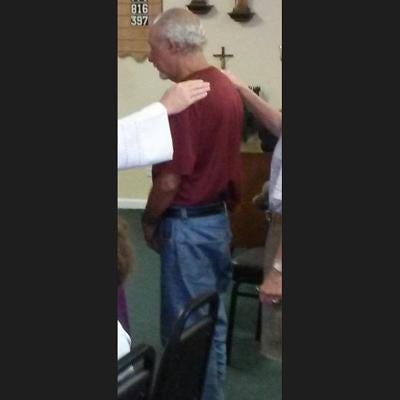
Yesterday I got word that Rudy passed away.
Rudy was a former parishioner of mine… though “parishioner” doesn’t quite capture it. Rudy lived, I approximate, two decades or more on the streets. He struggled mightily with alcohol addiction. And when I was newly ordained, I made Rudy my project.
I was going to “save” him.
I made a few calls and secured him a bed at a recovery center in Key West. It was a good program: safe, supportive, sober. I told him the good news and said, “Get in the car, we’re making the four-hour drive now.”
He told me no.
He said his life was here. His people. His business. Whatever that meant to him. And though he didn’t say it, I suspect he wasn’t ready to give up drinking, which the program required.
I was devastated. I had worked so hard to arrange it for him.
(Narrator: I hadn’t actually worked very hard at all, but in my pride and naivety, it felt like I had. New Priests are prone to Messiah Complexes)
A few years later, I warned Rudy that if he came to Mass drunk again, I’d have to turn him away. The next week, he showed up again, this time hiding booze in an orange juice bottle. (I didn’t fall off the turnip truck yesterday.)
So, I stopped him at the doors of the church and turned him away.
He left the church. He never came back.
To this day I live with the discomfort of that moment. Did I do the right thing?
On one hand, Rudy made some parishioners very uncomfortable. He smelled. He was volatile. He was often intoxicated. But on the other hand…
Did he need the Eucharist?
Did he need those two hours in the air conditioning out of the Florida sun?
Did he need the coffee and donuts afterward for his literal sustenance?
Did my more “respectable” parishioners need to see him, to be reminded of their own blessings? To be pulled out of their comfort zones and into proximity with the poor?
Did I fail to do for him because I failed to do for the least of these?
That’s a question I plan to ask the Lord when I meet Him.
My guess is that Jesus won’t give me a direct answer. He’ll respond with a parable, or a riddle, or a question of his own. Because that’s what Jesus does, He invites us to search our hearts. The Law is already written there, after all.
But I told you this story not to make you feel sorry for Rudy, or for me, but to show how complex the issue of homelessness really is.
And at the heart of that complexity is a question you may not expect:
Free will.
Because if human beings truly had free will in the way we like to imagine, Rudy would’ve gotten in the car that day. He would’ve gotten sober. He would’ve reconnected with family, found housing, and turned his life around.
But addiction is stronger than willpower. So is untreated trauma. So is mental illness. So is fear.
And now this past week, the President has signed an executive order allowing authorities to forcibly remove homeless individuals from the streets, putting them into mental institutions, jails, or state care.
The rationale, I suppose, is that if people can’t leave street life willingly, we’ll take that will from them.
All I can say is: I hope this works better than it sounds.
Because it is not good for anyone to live on the street. It’s dangerous, dehumanizing, and often deadly. But America has a long, disturbing history of what happens when we force institutional care on the most vulnerable, especially those with no one to advocate for them.
And here’s the deeper problem: You cannot coerce someone into healing.
Recovery, when it happens, is almost always born from rock bottom, from a moment of clarity, from grace… and always, always from within.
The real way to end homelessness isn’t with a pen stroke. It’s with prevention. It’s with mental health care, addiction support, housing access, job training, reproductive care, and a functioning social and economic safety net.
It’s giving people the means to modest prosperity and a reason to be alive.
It’s not a clean or easy solution, but Christ never called us to that which is easy.
He called us to the cross.
He called us to the margins.
He called us to Rudy.
If Rudy’s story moved something in you, I’d love to hear it. Leave a comment, share this post, or forward it to someone who needs to be reminded of the complexity—and the dignity—of every human life. These aren’t easy conversations, but they matter. And the more we wrestle with them together, the closer we get to the kind of world Jesus actually called us to build.
My priest often talks about “meeting people where they are”. And. I think the more uncomfortable that place where someone is to us, the harder it is to be present to them there. IDK - I have to believe that all things work together for good for those who are called according to His purpose - and you are definitely called to His purpose. So something about that encounter was as it was supposed to be. Either for you or Rudy or - most likely - both of you.
Very well said and heart searching...thanks Fr. Rich!