
What Can Grow Here?
Some wounds cannot simply be easily cleared away. The question becomes, what can still grow there?

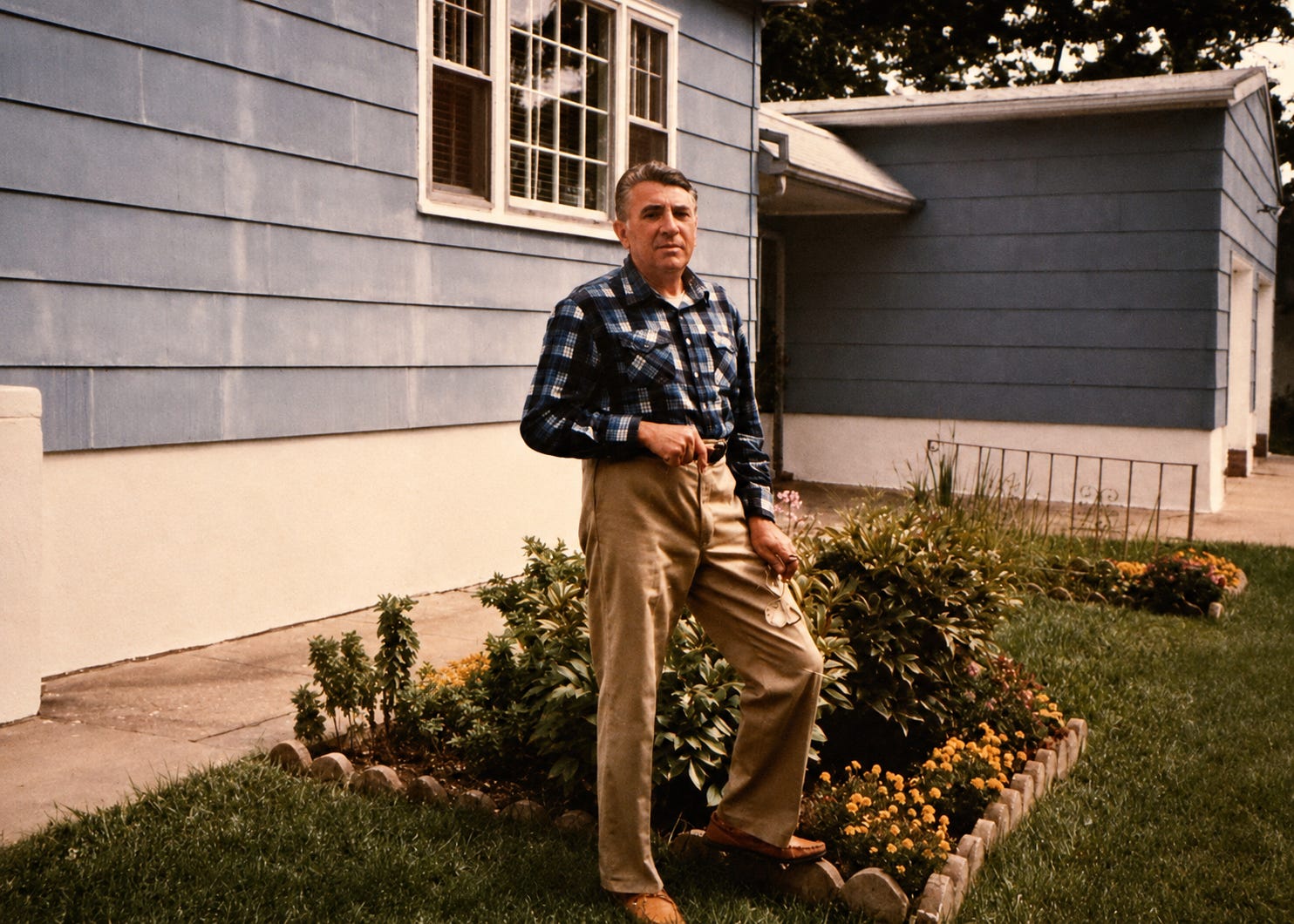
This is the closest photo I could easily find of my grandfather in the garden. This little flower bed by the entrance to the house was Grandpa’s “auxiliary garden.” If you look closely, you can see herbs and a few other useful things tucked in among the flowers, so Grandma could step outside and grab something fresh while she was cooking.
Before we begin, I just want to say something as I do each Sunday.
I love this community with all my heart. I am grateful for the way we gather here, for the prayers we share, for the questions you ask, and for the trust you place in me each week. I am thankful for every reader who chooses to support it. This little corner of the internet has become a real place of faith, friendship, and care.
But no digital community can fully take the place of being part of a parish, standing beside other people, hearing the Scriptures proclaimed, singing the hymns, and receiving the Body and Blood of Christ.
So, if you have access to a church that is safe, healthy, and spiritually nourishing, I hope you will make an effort to go. Let this reflection accompany your worship, not replace it.
If you are not ready, if you have been wounded by the Church, or if you simply do not have access to a supportive parish right now, then let this be your church for today.
And if ever you want some help finding a parish in your area that aligns with the values we share here, I’d be happy to be of service, just shoot me an email.
You are welcome here. It is the honor of my life to serve you. Let us pray together.
Your Brother in Christ,

Today’s Readings
Fifteenth Sunday in Ordinary Time
The First Reading
Isaiah 55:10–11
A reading from the Book of the Prophet Isaiah.
For as the rain comes down and the snow from the sky,
and doesn’t return there,
but waters the earth,
and makes it grow and bud,
and gives seed to the sower and bread to the eater;so is my word that goes out of my mouth:
it will not return to me void,
but it will accomplish that which I please,
and it will prosper in the thing I sent it to do.
The Word of the Lord.
Thanks be to God.
The Second Reading
Romans 8:18–23
A reading from the Letter of Saint Paul to the Romans.
Brothers and sisters:
I consider that the sufferings of this present time are not worthy to be compared with the glory which will be revealed toward us.
For the creation waits with eager expectation for the children of God to be revealed. For the creation was subjected to vanity, not of its own will, but because of him who subjected it, in hope that the creation itself also will be delivered from the bondage of decay into the liberty of the glory of the children of God.
For we know that the whole creation groans and travails in pain together until now.
Not only so, but ourselves also, who have the first fruits of the Spirit, even we ourselves groan within ourselves, waiting for adoption, the redemption of our body.
The Word of the Lord.
Thanks be to God.
The Holy Gospel
Matthew 13:1–23
The Lord be with you.
And with your spirit.
A reading from the Holy Gospel according to Matthew.
Glory to you, O Lord.
On that day Jesus went out of the house and sat by the seaside. Great multitudes gathered to him, so that he entered into a boat and sat; and all the multitude stood on the beach.
He spoke to them many things in parables, saying:
“Behold, a farmer went out to sow. As he sowed, some seeds fell by the roadside, and the birds came and devoured them.
Others fell on rocky ground, where they didn’t have much soil, and immediately they sprang up, because they had no depth of earth. When the sun had risen, they were scorched. Because they had no root, they withered away.
Others fell among thorns. The thorns grew up and choked them.
Others fell on good soil and yielded fruit: some one hundred times as much, some sixty, and some thirty.
He who has ears to hear, let him hear.”
The disciples came and said to him, “Why do you speak to them in parables?”
He answered them:
“To you it is given to know the mysteries of the Kingdom of Heaven, but it is not given to them. For whoever has, to him will be given, and he will have abundance; but whoever doesn’t have, from him will be taken away even that which he has.
Therefore I speak to them in parables, because seeing they don’t see, and hearing, they don’t hear, neither do they understand.
In them the prophecy of Isaiah is fulfilled, which says,
‘By hearing you will hear,
and will in no way understand;
seeing you will see,
and will in no way perceive.For this people’s heart has grown callous,
their ears are dull of hearing,
and they have closed their eyes;
or else perhaps they might perceive with their eyes,
hear with their ears,
understand with their heart,
and should turn again,
and I would heal them.’But blessed are your eyes, for they see; and your ears, for they hear. For most certainly I tell you that many prophets and righteous people desired to see the things which you see, and didn’t see them; and to hear the things which you hear, and didn’t hear them.
Hear, then, the parable of the farmer.
When anyone hears the word of the Kingdom and doesn’t understand it, the evil one comes and snatches away that which has been sown in his heart. This is what was sown by the roadside.
What was sown on the rocky places, this is he who hears the word and immediately receives it with joy; yet he has no root in himself, but endures for a while. When oppression or persecution arises because of the word, immediately he stumbles.
What was sown among the thorns, this is he who hears the word, but the cares of this age and the deceitfulness of riches choke the word, and he becomes unfruitful.
What was sown on the good ground, this is he who hears the word and understands it, who most certainly bears fruit and produces, some one hundred times as much, some sixty, and some thirty.”
The Gospel of the Lord.
Praise to you, Lord Jesus Christ.
Every Heart Is a Garden
We are not one kind of soil, and God is not finished cultivating any part of us.
The other day, I wrote about my grandfather in what became a very well-received post.
Grandpa was almost synonymous with his garden. While he was still able to tend it, he grew just about every fruit and vegetable imaginable. Tomatoes, peppers, beans, cucumbers, squash, berries, and several exotic things that could only be found in Sicily and Grandpa’s backyard.
Frankly, Grandpa ruined strawberries for me.
I have spent the rest of my life trying to find a strawberry that tastes even remotely as sweet as the ones he grew. I have yet to succeed. Grocery store strawberries may be enormous, shiny, and perfectly red, but most of them taste like someone misted a packing peanut.
Grandpa’s strawberries tasted like strawberries had been promised in the Book of Revelation.
Anywho, to a little kid, his garden seemed enormous. Vast. Practically agricultural. I am not entirely sure how large it actually was. Maybe half an acre? Maybe less. Childhood has a way of enlarging everything. A backyard becomes an entire country. A small hill becomes a mountain. A garden becomes a farm.
Grandpa would give me a few dollars to help him weed.
Now, I use the word “help” rather generously.
I suspect my primary contribution was asking whether we were finished yet, how much longer this was going to take, and whether I had already earned the money. I may also have removed one or two plants that were not technically weeds, but I am sure Grandpa has forgiven me by now.
Still, I learned something while following him through that garden.
Not every part of it was the same.
One patch received sunlight almost all day. Another fell into shade by the afternoon. Some sections held water longer after the rain. Some soil was dark and soft and seemed willing to grow almost anything. Other places were so stubbornly rocky that I became convinced the earth was manufacturing new stones overnight just to irritate us.
Grandpa knew all of it.
He knew where the tomatoes would thrive, where the strawberries would receive enough sun, and which plants needed to be moved because the place that looked perfectly good to me was clearly unacceptable to them.
You could not simply put anything anywhere and expect it to grow.
Different plants needed different light. Different amounts of water. Different depths. Different kinds of soil. Something that flourished beside the fence might barely survive near the house. A plant that did beautifully one year might need a different patch the next.
From a distance, it looked like one garden.
Up close, it was many different kinds of ground.
So are we.
When we hear Jesus tell the Parable of the Sower, there is a very human temptation to start assigning roles.
There is the good soil, which obviously always represents us.
We came to church. We opened the email. We are listening to the Gospel. We have already demonstrated excellent soil-related qualities.
Then there are the other people.
The rocky ones. The shallow ones. The distracted ones. The ones whose lives have become so tangled in thorns that we cannot imagine how anything holy could possibly grow there.
It is amazing how quickly a parable meant to examine our hearts can become a filing system for everyone else.
But I do not think most of us are one kind of soil.
I think we are gardens.
There are parts of us where the Word of God takes root almost immediately. Some of us are generous without having to think much about it. Some are patient with children, attentive to the elderly, or quick to notice the person standing alone in the room. Some teachings of Christ reach us and find good light, rich soil, and plenty of room to grow.
Then there are the rocky patches.
There are resentments we have been carrying for years, turning them over now and then, perhaps polishing them a little, but never quite removing them.
There are wounds we have protected for so long that we no longer know what life would look like without them.
There are fears that have hardened into habits. There are assumptions we do not examine. There are people for whom our commitment to Christian charity suddenly develops several important footnotes.
We may believe deeply in forgiveness, until we are asked to forgive somebody.
We may preach mercy with tremendous enthusiasm, provided the recipient has not personally annoyed us.
Twenty years of spiritual formation can disappear with remarkable speed when a certain person walks into the room.
There are shaded areas too.
Parts of ourselves we do not look at very closely. Habits we keep away from the light. Questions we avoid because we have a sneaking suspicion that God’s answer may require us to change, and we were rather hoping God would focus on changing everyone else.
Then there are the thorns.
Jesus speaks about the cares of the world and the lure of wealth choking the Word before it can bear fruit.
We know those thorns.
Anxiety can take up every inch of available space. Ambition can turn everyone around us into a measuring stick. Exhaustion can leave us with very little patience for God, our neighbors, or the person ahead of us at the self checkout who apparently is seeing a computer for the first time and never used a credit card before.
Something good may already be growing in us. Compassion may have begun to take root. Patience may be trying its level best. Faith may be reaching upward.
Then fear, noise, pressure, comparison, resentment, and the endless demands of modern life wrap themselves around it until the thing can barely breathe.
This is why the reading from Isaiah belongs so beautifully beside this Gospel.
God says that the rain and snow come down from heaven and do not return until they have watered the earth, making it fertile and fruitful. Then God says that the divine Word works in the same way. It goes out and does not return empty.
God does not send the Word simply to inspect the garden and announce which parts are disappointing.
God sends the Word to cultivate us.
The rain falls on the rich soil, certainly. But it also falls on the rocks. It reaches the shaded places. It soaks into ground packed hard by years of footsteps. It nourishes seeds buried so deeply that we may have forgotten they were ever planted.
The Word of God does more than tell us what we should already be.
It works on us.
It softens what has become hard. It disturbs what has grown too comfortable. It exposes what is choking our growth. It reaches into the corners we would rather leave alone, because we have already decorated around them and learned how to avoid looking directly at them.
Scripture does not merely congratulate the fertile parts of our lives.
It returns, again and again, to the ground that still needs tending.
God knows the whole garden.
The sunny places. The shaded places. The rich soil. The stubborn rocks. The thorns we planted ourselves and the ones that seemed to appear while we were simply trying to survive.
And still, God sends the rain.
Then Saint Paul adds another layer.
He writes, “I consider that the sufferings of this present time are as nothing compared with the glory to be revealed for us.”
Paul is not writing from a place of comfort. This is not a man reclining beside the Mediterranean with a pleasant beverage, offering inspirational thoughts about perseverance.
Paul knew hardship. He knew rejection, violence, uncertainty, imprisonment, and the sort of travel arrangements that would cause most of us to leave a very stern review.
Still, he speaks of creation waiting. Groaning, actually. He says that all creation is “groaning in labor pains” as it waits for redemption.
That is not especially tidy religious language.
Groaning is what we do when the pain has exceeded our vocabulary. It is what comes out when we are too tired to explain ourselves, too frightened to make sense of what is happening, or too overwhelmed to produce a respectable prayer.
Sometimes faith sounds like a hymn.
Sometimes it sounds like a groan.
Paul does not shame us for that. He includes the groaning within the life of faith. Creation groans. We groan. Even the Holy Spirit, he tells us a few verses later, meets us there with sighs too deep for words.
God is not scandalized when suffering leaves us without polished language.
But Paul also believes that the groaning is not meaningless. He compares it to labor pains, which means that something is being brought to birth, even when we cannot yet see it.
A garden has seasons too.
There are times when everything is green, sunlight is plentiful, and growth seems almost effortless. Then there are weeks when the heat refuses to break, the rain does not come, and every living thing begins to droop.
There are winters when the garden looks dead.
If you judged it only by what was visible, you might conclude that all the work had been wasted. Nothing appears to be growing. Nothing seems especially promising. The ground is cold, hard, and unimpressive.
But life has not necessarily disappeared.
Roots may be deepening. Seeds may be waiting. The soil may be undergoing changes we cannot observe from the surface.
The same is true of us.
We tend to reserve our most enthusiastic Christianity for seasons of good fortune.
It is easier to thank God when the diagnosis is favorable, the relationship is secure, the bills are paid, and the people around us are behaving themselves.
It is easier to be patient after a good night’s sleep.
It is easier to be generous when we feel we have enough.
It is easier to speak about mercy when nobody has recently hurt us.
Give us pleasant weather, manageable traffic, a cooperative family, and stable blood sugar, and many of us are nearly ready for canonization.
Hard seasons reveal where our roots have reached.
What happens to our charity when we are frightened?
What happens to our temperament when we are exhausted?
How do we treat people when we feel ignored, embarrassed, or underappreciated?
What happens to our generosity when resources feel scarce?
Do we still recognize the image of God in someone who is making our life more difficult?
Those questions are not meant to shame us. Suffering does not automatically make anyone wiser, kinder, or holier. Sometimes pain leaves us depleted. Sometimes it makes us reactive. Sometimes getting through the day requires nearly everything we have.
A person who is barely surviving does not need a priest standing nearby with a clipboard, evaluating the quality of the spiritual fruit.
But the hard seasons do show us where cultivation is still needed.
They reveal the difference between the virtues we admire and the virtues we have practiced deeply enough to rely upon.
We may think of ourselves as patient until life asks us to wait.
We may think of ourselves as forgiving until somebody causes real harm.
We may think of ourselves as compassionate until compassion becomes inconvenient, expensive, or socially unpopular.
The difficult season did not necessarily create the rocky place. It may simply have exposed it.
And exposure, uncomfortable as it can be, gives God somewhere to work.
Christian virtue is not cultivated only when life is pleasant. It grows through repetition, repentance, failure, and beginning again. It grows when we catch ourselves becoming cruel and choose to stop. It grows when we apologize without explaining away what we did. It grows when we refuse to let fear decide how another human being will be treated.
Some of the holiest moments in our lives will not feel holy while they are happening.
They may look like holding our tongue.
Making the phone call.
Admitting we were wrong.
Offering kindness when we would much rather offer a detailed presentation explaining why the other person is unbearable.
This is slow work.
Gardens usually are.
Now, it would be very easy for me to stand here and say, “When you find a rocky part of your life, clear out the stones. Break up the ground. Make it soft and fertile.”
That would make for a tidy homily.
It would also be terribly unfair.
I respect you too much, and I know enough about the human heart, to pretend that every rocky place can be cleared with a little prayer, determination, and a free Saturday afternoon.
Sometimes you begin digging and discover that what looked like a stone on the surface is a boulder hiding beneath the ground.
It may not be impossible to remove. But it is going to require more strength, more time, more help, and considerably more equipment than you expected when you first picked up the shovel.
I think most of us have a boulder somewhere in the garden.
It may be the family member we do not know how we will ever forgive.
It may be the effects of abuse in childhood, still shaping our nervous system, our relationships, and our understanding of ourselves decades later.
It may be the fear of abandonment, learned when someone promised to love us unconditionally and then failed to keep that promise.
It may be the lingering repercussions of addiction, whether our own or someone else’s.
It may be grief that simply will not quit. The kind that returns without warning, in the grocery store, in the car, or halfway through an ordinary Tuesday when we thought we were doing perfectly well.
It may be an illness that changed the shape of our life. A betrayal we survived but never fully understood. A fear that has lived within us for so long that we can no longer remember who we were before it arrived.
Those things do not disappear because someone tells us to “let go and let God.”
Frankly, I would love to let go of that particular phrase for good.
Some wounds require years of care. Some require therapy, medication, spiritual direction, honest conversations, firm boundaries, or a kind of forgiveness that develops slowly and may never include reconciliation.
Some boulders may remain in the ground.
That does not make the garden a failure.
A wise gardener does not stand over a difficult patch of earth demanding that it become something it cannot yet become. The gardener asks a better question:
What can grow here?
Perhaps this is not where you plant the tomatoes, with their deep and hungry roots.
Perhaps this is where you plant lettuce or spinach.
Perhaps basil.
Plants with shallower roots. Plants that may be more delicate and require a little more attention.
But they are no less alive.
They are no less beautiful.
They are no less worthy of a place in the garden.
There may be parts of your life where great, towering spiritual achievements are not possible right now. Perhaps the most faithful thing you can grow there is the willingness to get out of bed. The courage to ask for help. The decision not to return the cruelty you received. The ability to pray one honest sentence instead of pretending everything is fine.
Perhaps forgiveness cannot grow there yet.
Could a boundary grow?
Could honesty?
Could the smallest sprig of compassion, even if it is only compassion for yourself?
Could you grow enough trust to let another person help you tend that part of the garden?
We can become so impressed by deep roots and enormous fruit that we overlook the holiness of smaller growth.
A fragile plant is still a living thing.
A shallow root is still reaching.
A leaf pushing through difficult soil is not a failure because it did not become an oak tree.
God does not demand the same crop from every part of us.
God asks us to tend the ground we actually have.
This is part of what Saint Paul means when he speaks of creation groaning in labor pains. Growth is not always graceful. Sometimes it is slow, painful, incomplete, and nearly invisible.
Still, something can grow.
Even there.
So where does all of this leave us?
It leaves us with a Sower who keeps sowing.
That may be the most remarkable part of Jesus’ parable. The Sower is almost scandalously generous with the seed. He does not pause to conduct a soil analysis. He does not inspect each patch, shake his head, and decide that some ground is simply not worth the trouble.
He scatters the seed everywhere.
On the good soil.
Among the thorns.
Across the rocks.
Even onto the path where people have been walking for so long that the earth has become hard beneath their feet.
God keeps sowing because God has not given up on any part of the garden.
Not the fruitful places. Not the neglected places. Not the places we have tried to repair a dozen times and somehow made worse. Not even the places where the boulder remains beneath the surface and the best we can manage, for now, is a small patch of basil.
God can work with basil.
God can work with one honest prayer spoken through clenched teeth.
God can work with a boundary where reconciliation is not safe.
God can work with the decision to seek help.
God can work with the apology we should have made ten years ago but finally found the courage to offer this morning.
God can work with the smallest living thing we are able to grow.
We often imagine spiritual maturity as becoming one great stretch of flawless, fertile soil. Every virtue in bloom. Every resentment uprooted. Every thorn neatly removed. Nothing but holiness as far as the eye can see.
I have never met that person.
I have met people with magnificent gardens, but every one of them still has a troublesome corner. Every one still has weeds. Every one still has a place that does not receive enough light, a plant that refuses to cooperate, or a mystery sprouting near the fence that nobody remembers planting.
That is the human heart.
Christian life is not the achievement of perfect soil. It is the willingness to let God keep cultivating us.
That work happens in every season.
Saint Paul speaks of creation groaning in labor pains, waiting for the fullness of redemption. He does not describe a world that has already arrived. He describes a world in the process of becoming.
So are we.
There are seasons when the growth is obvious. Prayer comes easily. Mercy feels natural. We know what God is asking, and for once, we even feel like doing it.
Enjoy those seasons. They are wonderful.
There are other seasons when the garden seems to be engaged in a coordinated rebellion. Nothing grows where we planted it. The weeds are thriving beyond all reasonable expectation. Something has eaten half the tomatoes, and we are beginning to suspect it may have been the neighbor.
Those seasons belong to the life of faith too.
The question is not whether every part of us is producing an impressive harvest today.
The question is whether we will allow God to keep tending the ground.
Can we let the Word reach the places we normally defend?
Can we admit where fear, resentment, or exhaustion has narrowed our charity?
Can we stop demanding that every wounded part of us produce the same fruit as the places that have known plenty of sunlight and rain?
Can we ask, with honesty and without shame, “Lord, what can grow here?”
Sometimes the answer will be forgiveness.
Sometimes it will be courage.
Sometimes it will be patience, repentance, or generosity.
Sometimes it will be a very small, fragile thing. The willingness to try again. The strength to make one phone call. The decision to remain kind for the next ten minutes.
Do not despise that growth.
A gardener does not look at the first green shoot breaking through the soil and complain that it has failed to become a tree.
The gardener sees life.
God sees life too.
I do not remember much of what I planted in Grandpa’s garden. I am reasonably certain that my contribution to the harvest was minimal. But I remember walking through the rows beside him. I remember the sun, the soil, the endless weeds, and the certainty that he knew what belonged where.
Grandpa understood the garden better than I did.
God understands us better than we understand ourselves.
God knows which parts need more light. Which need rest. Which need water. Which need to be cut back. Where the hungry rabbit likes to hang out. Which stone can be removed today, and which boulder will require patience, help, and time.
Our lives may contain fertile soil, stubborn rocks, shaded corners, thorns, and a few plants hanging on by what appears to be sheer spite.
It is still one garden.
It is still loved.
And God is still sending the rain.
Prayer
Loving God,
You know every part of us.
You see the places where faith has taken root and begun to bear fruit. You also see the places that remain rocky, crowded, wounded, and afraid.
Send your Word into us again.
Soften what has become hard. Clear away the resentment, anxiety, pride, and exhaustion that choke the life you are trying to grow. Give us the courage to examine the limits of our charity, especially when we are tired, frightened, disappointed, or convinced that we are right.
Do not let us mistake good fortune for holiness, or difficulty for abandonment.
Cultivate in us a faith that survives every season. Teach us to remain merciful when mercy is costly, patient when patience feels impossible, and generous when we are tempted to close our hands.
When our lives seem barren, help us trust that you are still working beneath the surface.
Keep sowing, Lord.
Keep watering.
Keep making us into the people you created us to become.
Amen.
And Now It’s Your Turn…
Where in your life are you learning to ask, “What can grow here?” Is there a rocky place, a lingering wound, or a difficult season where God may be cultivating something smaller, slower, but still deeply good?
Share your thoughts in the comments. Your reflection may help someone else recognize growth in a place they had already written off.
And if this homily brought someone to mind, please share it with them. Sometimes a few words arrive at exactly the right moment.
Hit the Collection Plate
If Message From the Margins has become part of your spiritual life, consider becoming a paid subscriber. Your support helps make these homilies, essays, prayers, and pastoral resources possible, and it allows me to keep this work accessible to everyone, including those who cannot afford to contribute.
Think of it as passing the collection plate through our little digital parish.
I appreciate your invite to go to mass even if it’s been awhile. I did just that yesterday after a hiatus of several months. For one thing I am divorced and remarried. I feel like I need forgiveness for my decisions. I don’t like feeling like a sinner or an outcast. I pray to feel God’s love.
Full stop message today! How many times I’ve read/heard The Parable of the Sower and immediately assigned myself - and others - to a particular soil. I had it in my brain that once in the rocky soil or hard soil it was “game over”. Today’s message made me look at the sowing and the soil in a different light. We are not hopelessly stuck in one soil type. Thank you Father Rich!