
Good Ground for Hope
Why God leaves the weeds in the field, and what they reveal about the kind of wheat we are becoming.

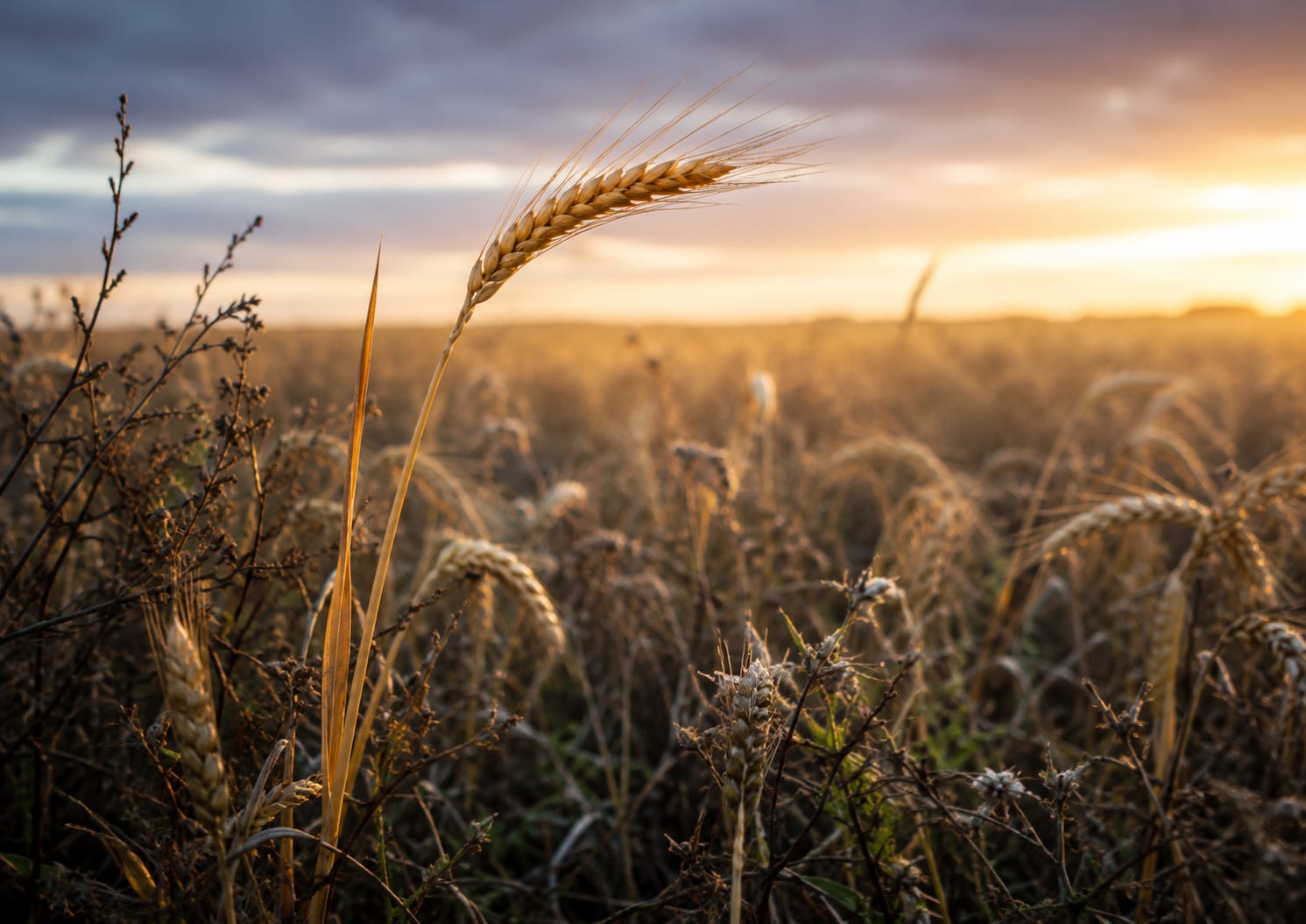
Just a word before we begin…
Providing this ministry is one of the great honors of my life. I love sharing daily reflections and Sunday homilies with you, and I am deeply grateful for the community being built in the comments.
But no newsletter, no matter how good, or bad for that matter, can take the place of life in your parish.
I am more aware than ever that this is an ecumenical ministry, made up of people from many churches and faith traditions. Still, nothing replaces gathering together as the Body of Christ, hearing the Word of God proclaimed, praying beside one another, and sharing in the breaking of the bread.
I am not there to see you cry during the reading, or notice when you linger a few extra moments in prayer, or find you during coffee hour and ask if everything is all right. Your local community can do what a screen never can.
So, if you are able, please consider making it to a Sunday service today. And if you come from a Eucharistic tradition, receive Jesus in the Blessed Sacrament.
And if you ever need help finding a church that is welcoming, safe, affirming, and shares our Gospel values, email me. I would be happy to help you find a parish in your area.
Your Brother in Christ,

The Readings
Sixteenth Sunday in Ordinary Time
Lectionary: 106
First Reading
Wisdom 12:13, 16–19
There is no god besides you who have the care of all,
that you need show you have not unjustly condemned.
For your might is the source of justice;
your mastery over all things makes you lenient to all.
For you show your might when the perfection of your power is disbelieved;
and in those who know you, you rebuke temerity.
But though you are master of might, you judge with clemency,
and with much lenience you govern us;
for power, whenever you will, attends you.
And you taught your people, by these deeds,
that those who are just must be kind;
and you gave your children good ground for hope
that you would permit repentance for their sins.
Responsorial Psalm
Psalm 86:5–6, 9–10, 15–16
Response: Lord, you are good and forgiving.
You, O LORD, are good and forgiving,
abounding in kindness to all who call upon you.
Hearken, O LORD, to my prayer
and attend to the sound of my pleading.
Response: Lord, you are good and forgiving.
All the nations you have made shall come
and worship you, O LORD,
and glorify your name.
For you are great, and you do wondrous deeds;
you alone are God.
Response: Lord, you are good and forgiving.
You, O LORD, are a God merciful and gracious,
slow to anger, abounding in kindness and fidelity.
Turn toward me, and have pity on me;
give your strength to your servant.
Response: Lord, you are good and forgiving.
Second Reading
Romans 8:26–27
Brothers and sisters:
The Spirit comes to the aid of our weakness;
for we do not know how to pray as we ought,
but the Spirit himself intercedes with inexpressible groanings.
And the one who searches hearts
knows what is the intention of the Spirit,
because he intercedes for the holy ones
according to God’s will.
Gospel
Matthew 13:24–43
Jesus proposed another parable to the crowds, saying:
“The kingdom of heaven may be likened to a man
who sowed good seed in his field.
While everyone was asleep his enemy came
and sowed weeds all through the wheat, and then went off.
When the crop grew and bore fruit,
the weeds appeared as well.
The slaves of the householder came to him and said,
‘Master, did you not sow good seed in your field?
Where have the weeds come from?’
He answered, ‘An enemy has done this.’
His slaves said to him,
‘Do you want us to go and pull them up?’
He replied, ‘No, if you pull up the weeds
you might uproot the wheat along with them.
Let them grow together until harvest;
then at harvest time I will say to the harvesters,
“First collect the weeds and tie them in bundles for burning;
but gather the wheat into my barn.”’”
Good Ground for Hope
How often have you wished that God would simply come down and remove all the bad people?
All the cruel people. All the corrupt people. All the people who lie, exploit, manipulate, and hurt others without seeming to lose a moment of sleep over it.
Perhaps one particular person even comes to mind.
“Lord, I am surely among the wheat. Please take these weeds away from me, throw them into the fire, and let the rest of us get on with being good people.”
Enough already.
It seems like a saintly enough prayer.
Why should people who are trying to live decently have to share the field with people who seem determined to ruin it? Why should those who tell the truth have to live alongside liars? Why should people who seek peace have to contend with those who profit from chaos? Why should the vulnerable have to wait while powerful people continue doing harm?
Go ahead, Lord. Pull up the weeds.
Yet in today’s Gospel, the master says something peculiar:
“No, if you pull up the weeds, you might uproot the wheat along with them.”
Now, surely the angels are precise enough to tell the difference.
I have to imagine that angels are better at gardening than I am. They are not going to confuse a stalk of wheat with a weed, lose their balance, and accidentally yank up three rows of good crops.
Surely God could remove every evildoer with perfect accuracy, leaving the rest of us free to flourish, unencumbered by all those terrible people.
But I am going to go out on a limb here and say that Jesus does not make mistakes.
So what could this mean?
Why might it be important that the weeds are not immediately removed?
Our first answer may come from Saint Paul.
Paul tells us that “we do not know how to pray as we ought.”
That is certainly true for me, at least when it comes to my first inclinations.
Sometimes my first prayer is not particularly holy.
Sometimes it is simply, “Lord, make this person stop.”
Sometimes it is, “Lord, make them understand.”
Sometimes it is, “Lord, prove me right.”
And sometimes, if we are being honest, the prayer beneath the prayer is, “Lord, punish them until they become the person I think they should be.”
Paul says that the Holy Spirit comes to the aid of our weakness. The Spirit intercedes for us because our first prayer may be too small, too angry, too frightened, or too certain of our own innocence.
We ask God to remove another person.
The Spirit may be asking God to transform them.
We ask God to defeat our enemy.
The Spirit may be asking God to save them.
We ask God to prove that we are wheat.
The Spirit may be asking God to show us the weeds growing within our own hearts.
One of the great mysteries of faith is that we do not always know where the line between wheat and weed actually runs.
Am I wheat?
I certainly hope so.
Am I a weed?
There are people in my social media comments who are very convinced that I am.
And I suppose that is part of the problem.
Every side believes it can identify the weeds. Every group believes the field would be healthier if certain other people were removed from it.
History is filled with people who were absolutely certain that they were protecting the wheat.
Churches have driven people away to protect the wheat.
Nations have imprisoned, deported, and killed people to protect the wheat.
Families have rejected their own children because someone convinced them that love required pulling up a weed.
Again and again, human beings have mistaken cruelty for cultivation.
And before we congratulate ourselves for seeing their mistake, we should remember that they were often every bit as certain as we are.
Jesus knows what happens when frightened people become convinced that they can identify evil with perfect accuracy.
Innocent people get uprooted.
Vulnerable people get trampled.
And those doing the uprooting often become the very thing they believed they were fighting.
This does not mean that we ignore evil.
Mercy does not mean passivity. We may need boundaries, consequences, courts, and protection for those in danger.
We can stop someone from doing harm without declaring that person beyond the reach of grace.
We can resist evil without claiming authority over the final condition of another human soul.
That judgment belongs to God.
And the Book of Wisdom tells us what God does with that authority.
Though God is “master of might,” God judges with clemency. God governs with lenience.
God’s power is so complete that God does not need to prove it through cruelty.
Cruelty is often the performance of insecure power.
People who are afraid of losing control become harsh. People who doubt their authority demand constant displays of submission. People who are uncertain of their own righteousness become obsessed with punishing somebody else’s sins.
But God has nothing to prove.
God is powerful enough to be patient.
God is secure enough to be merciful.
God is just enough to be kind.
Wisdom says that through this lenience, God teaches the just that they also must be kind.
Kindness is not a departure from justice. It is one of the ways divine justice differs from human vengeance.
Then comes one of the most beautiful lines in all of today’s readings:
“You gave your children good ground for hope that you would permit repentance for their sins.”
Good ground for hope.
Perhaps that is why the field remains undisturbed.
God leaves good ground for hope.
God gives the person who is doing wrong another morning in which to turn around.
God gives the person whose heart has hardened another encounter that might soften it.
God gives the liar another opportunity to tell the truth.
God gives the hateful person another chance to be changed by love.
God gives the powerful another moment in which they might finally see the people they have harmed.
And God gives us another day to repent of the weeds within ourselves.
Because none of us is pure wheat.
Within every human heart, wheat and weeds grow together.
There is generosity in us, and there is selfishness.
There is courage, and there is cowardice.
There are moments when we reveal the compassion of Christ, and moments when we are petty, impatient, jealous, or needlessly cruel.
We are complicated fields.
And thank God that every time a weed appeared in us, God did not tear us out by the roots.
Thank God we were given time.
Thank God we were given teachers, friends, sacraments, consequences, second chances, and moments of grace.
Thank God someone believed there was still wheat growing in us, even when the weeds were easier to see.
God leaves the field intact because mercy requires time, and because none of us has finished growing.
Perhaps living beside the weeds also teaches the wheat how to grow.
We see something like this written into creation itself.
Living things often develop resilience under pressure. Roots reach more deeply when water is scarce. Plants adapt to difficult soil. Life learns how to endure conditions it never would have chosen.
Some adversity strengthens us. Some of it wounds us deeply.
We should never romanticize suffering or tell someone that God harmed them simply to make them stronger.
Grace is not the suffering itself.
Grace is what God continues to grow in us despite it.
The wheat that manages to flourish despite the weeds may become hardier. It learns to survive dry seasons, infestations, and imperfect care. It grows in conditions it never would have chosen, and somehow it continues reaching toward the sun.
Perhaps there is something here for the life of faith.
We do not become holy simply because every difficult person has been removed, every temptation has disappeared, and every circumstance has been arranged for our comfort.
We become holy by learning, with the help of grace, how to remain truthful in a dishonest world, compassionate in a cruel one, and faithful when faithfulness costs us something.
The weeds do not make the wheat good.
But the wheat’s refusal to become a weed reveals the strength of what God has planted within it.
Will another person’s hatred make us hateful?
Will their cruelty give us permission to become cruel?
Will their dishonesty convince us that honesty is useless?
The great spiritual danger is not only that evil people may harm us.
It is that, while fighting them, we may begin to resemble them.
Jesus refuses to let the weeds determine the character of the wheat.
So yes, resist evil.
Protect the vulnerable.
Tell the truth.
Set boundaries.
Challenge injustice.
But do not surrender your soul to the people whose behavior you oppose.
Do not let their hatred teach you how to hate.
Do not let their cruelty become your excuse for cruelty.
Do not let your certainty about their sin blind you to your own need for mercy.
The field belongs to God.
The harvest belongs to God.
The final judgment belongs to God.
Our task is to keep growing toward the light without allowing the darkness around us to take root within us.
And perhaps, when we are tempted to ask God to pull someone else up by the roots, we might pray instead:
“Lord, protect those who are being harmed.
Stop the evil that is being done.
Change the heart of the one doing it.
And do not allow their sin to take root in me.”
That is good ground for justice, mercy, repentance, and hope.
Amen.
And Now It’s Your Turn
Where have you been tempted to decide too quickly who is wheat and who is weed?
Is there someone whose wrongdoing has begun to shape your own heart, making you more angry, bitter, or cruel than you want to be?
And where might God still be giving you good ground for hope, time to repent, to heal, to grow, or to become more deeply rooted in grace?
Please consider sharing this reflection with someone who may need a little good ground for hope today.
Closing Prayer
God of patience and mercy,
Teach us to trust your wisdom when we are tempted to judge too quickly.
Protect those who are being harmed. Restrain what is cruel and unjust. Soften the hearts of those who do wrong, and keep their sin from taking root within us.
Give us the courage to remain truthful in a dishonest world, compassionate in a cruel one, and faithful when faithfulness costs us something.
Help us grow toward the light, bearing good fruit even in an imperfect field.
And when we do not know how to pray as we ought, let your Spirit pray within us.
Through Christ our Lord.
Amen.
Let Us Pass the Collection Plate
If this ministry nourishes your faith, please consider becoming a paid subscriber. Your support helps make these daily reflections, Sunday homilies, and pastoral resources possible.
Amen 🙏🏼
The temptation is always to assume we are the wheat and the people driving us insane are the weeds. Conveniently, God keeps refusing to confirm our seating chart. This does not mean tolerating cruelty or confusing mercy with passivity. Protect people, confront harm, set boundaries, and use the courts when necessary. But the moment hatred becomes our method, the weeds have already crossed the property line. The hardest spiritual work is not defeating evil. It is resisting evil without letting it reproduce inside us. Apparently even righteousness requires weed control.